Brush names matter less than the mark a particular brush makes in your hand. Compare the tip shape, spring, width, and paint load, then practice the stroke before deciding which brush belongs in your working kit.
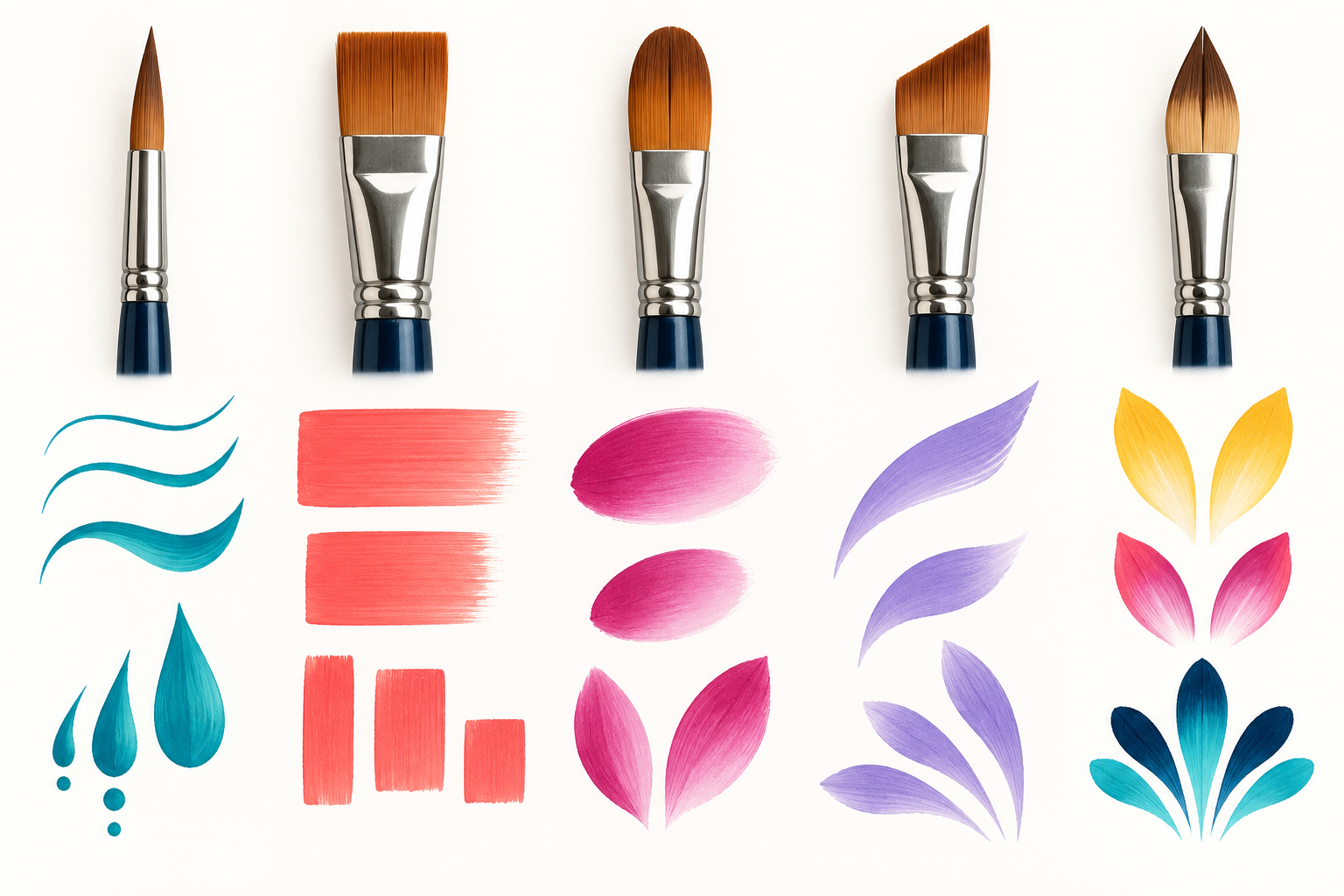
Round brushes: lines, points, curls, and teardrops
A round brush narrows toward a point. With light pressure it can make fine outlines and details; increasing pressure spreads the bristles for a thicker line. Pressing and lifting can create teardrops and tapered marks.
Choose a smaller round for controlled detail and a larger one when you want a fuller line or larger teardrop. A good point helps, but water balance and loading affect the result just as much as the printed size.
Flat brushes: blocks, ribbons, and broad coverage
A flat brush has a straight, squared edge. The full width produces a broad band, while the narrow edge can make a thinner line. Loaded with more than one color, it can place adjacent bands in a single stroke.
Flat brushes are useful for geometric areas, quick color placement, rainbows, and one-stroke structures. They are not automatically the best choice for every large area; match the width and stiffness to the placement and desired edge.
Filbert brushes: soft ovals and rounded shapes
A filbert resembles a flat brush with a rounded tip. It can create softer-ended bands, oval marks, leaves, and rounded fills without the square corners of a conventional flat brush.
This shape can be helpful when a design needs soft ears, petals, scales, or rounded accents. Turning or dragging it changes the mark, so test both the full face and the edge.
Angled brushes: directional and tapered strokes
An angled brush has a slanted edge that naturally produces a leading point and a broader trailing section. It can help with directional leaves, eyebrows, wings, sharp curves, and controlled one-stroke shapes.
Orientation matters: reversing the brush changes which side leads. Practice the motion in both directions before relying on it during a symmetrical design.
Petal or dagger brushes: petals and paired tapered marks
Brushes sold as petal or dagger shapes vary, but typically combine a wider body with a pointed or split-looking tip. A press-and-lift motion can create petals, leaves, and decorative tapered clusters.
The brush does not create a finished flower by itself. Paint consistency, loading, angle, pressure, and the speed of the lift all influence whether the stroke stays crisp.
How to compare brushes before buying more
- Load each brush with the same cosmetic-grade paint consistency.
- Make a light line, a pressure line, a press-and-lift mark, and a curved stroke.
- Note whether the tip returns to shape and whether the handle feels controllable.
- Repeat after cleaning so you can assess consistency rather than one lucky stroke.
- Keep the brushes that solve recurring design tasks instead of collecting every available shape.
Care affects brush performance
Follow the brush and cosmetic-product manufacturers' cleaning and storage directions. Avoid crushing wet tips into containers, and let brushes dry in an appropriate position before enclosed storage. Retire a brush if damaged bristles, a loose ferrule, residue, or another condition makes it unsuitable for service.
Apply the shapes in real designs
Practice tapered round-brush linework with the tiger guide, rounded and directional strokes with the floral vines guide, and small decorative details with the princess guide. The goal is not to prescribe one brush—it is to connect each tool to a visible outcome.