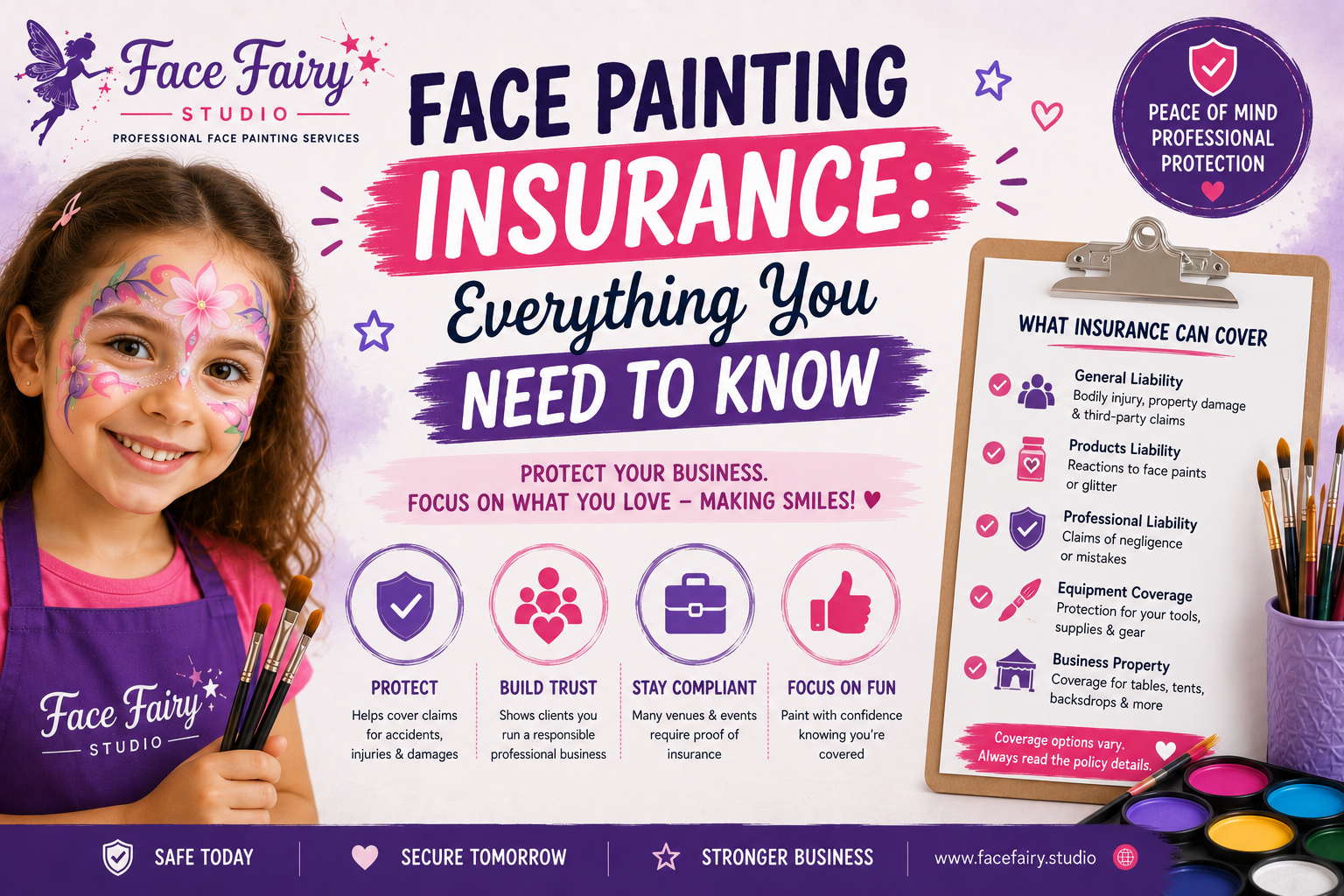
Face painters may be asked for liability insurance before working at a venue, school, festival, corporate event, or private booking. The useful question is not simply whether a painter “has insurance,” but whether the actual policy and documentation fit the work, people, locations, and contractual requirements involved.
Do face painters need liability insurance?
There is no single answer that applies to every face painter in every location. Legal requirements vary, and insurance needs depend on how the business operates. Separately, a venue or client can require specified coverage as a condition of the booking even when no general rule requires every painter to carry it.
Working face painters should consider the environments they enter, how their setup interacts with guests, what products they apply, whether anyone assists them, and what their contracts promise. Insurance is one part of risk management; clear procedures, professional products, sanitation, careful setup, and accurate client communication still matter.
Why a venue or organizer may request insurance
Schools, municipalities, festivals, property managers, and corporate clients often have vendor requirements designed to manage risk across an event. They may request a Certificate of Insurance, minimum limits, particular policy dates, or additional-insured wording. These are not interchangeable requests.
Ask for the requirement in writing before accepting the event. Send it to your insurer or broker rather than promising that your existing policy satisfies it. A last-minute request can delay approval if the policy needs review or the insurer needs time to issue documents.
Practical risks in a face-painting business
Potential incidents are not limited to the painted design. A person might interact with chairs, tables, cases, signs, water containers, cords, or queue space. Products and tools are handled around skin and eyes. Equipment could be damaged or stolen. Travel, employees, subcontractors, and work at unusual venues can introduce separate questions.
Listing the real activities of the business helps an insurance professional understand what must be evaluated. It does not mean every incident is covered. Never infer coverage from a marketing summary or from the fact that a policy is labeled “general liability.”
What general liability insurance generally means
Commercial general liability commonly addresses certain third-party bodily-injury, property-damage, and related claims, subject to the policy. That broad description is not a coverage guarantee. Definitions, exclusions, endorsements, deductibles, limits, reporting duties, and the circumstances of a claim determine how a policy responds.
Ask the provider to confirm that your declared business operations accurately describe face painting and any related services you offer. If you also provide glitter tattoos, balloons, hair accessories, henna, classes, retail products, or other entertainment, disclose those activities and ask how they are treated.
What is a Certificate of Insurance?
A Certificate of Insurance, commonly called a COI, summarizes specified policy information at the time it is issued. It usually identifies the insured, insurer, policy types, dates, and limits. A certificate is evidence of coverage; it is not the insurance contract and does not create coverage that the policy does not provide.
A client may ask to be listed as a certificate holder. They may separately request additional-insured status or specific wording. Do not treat those terms as synonyms. Forward the client's written instructions to the insurer and let the insurer confirm what can be issued.
A practical venue and COI workflow
- Ask the organizer whether vendor insurance is required before finalizing the quote.
- Collect the legal entity name, address, event dates, venue, required limits, and exact wording.
- Send the written request to the insurer or broker and explain the services you will perform.
- Review any cost, endorsement, or restriction before committing to the client.
- Send the issued document to the requested contact and retain a copy with the booking record.
- Reconfirm if the venue, dates, services, or contracting entity changes.
Coverage questions to discuss with an insurer
- Are face painting and every related service I provide accurately described operations?
- How does the policy address products applied to a person's skin?
- What bodily-injury and property-damage limits apply, and is there an aggregate limit?
- Which exclusions or endorsements are especially relevant to children, cosmetics, temporary art, or events?
- Can additional-insured documents be issued, and are there fees or restrictions?
- Does coverage follow the business to every state, venue type, festival, school, or private residence where it may work?
- How are assistants, employees, subcontractors, or other artists treated?
- What notification and documentation duties apply if something happens?
Policy exclusions and limits deserve careful review
A policy can contain limits for each occurrence and across the policy period, along with exclusions that remove particular activities or events from coverage. An endorsement can add, restrict, or clarify terms. Ask questions in writing when possible and keep the answers with your policy records.
Do not tell a client that insurance “covers allergic reactions,” a specific product, or every accident unless the insurer has addressed the relevant scenario and policy language. Even then, a future claim decision depends on its facts and the contract in force.
Assistants, employees, and additional artists
Do not assume your policy automatically covers anyone helping at an event. The answer may differ for an employee, independent contractor, volunteer, or separate business. Workers' compensation and employment requirements can also be separate from general liability. Explain each working arrangement to an appropriately licensed professional.
Equipment and property considerations
General liability should not be assumed to cover loss, theft, or damage to your own paints, furniture, electronics, signage, or vehicle. Ask whether business personal property, inland marine, commercial auto, or other coverage is relevant to the equipment you transport and use.
Comparing per-event and annual policy formats
Some providers may offer short-term or per-event arrangements as well as annual policies. Availability varies by provider, activity, location, and event, so compare more than the premium: review the scope, exclusions, documentation support, and exact effective dates. Annual coverage may simplify repeated venue requests, but suitability depends on your actual business activity and the policy terms. If you are considering short-term coverage, ask whether it can support any COIs or additional-insured requests required for the event.
What to do when a client requests proof of insurance
Respond promptly, but do not edit a certificate yourself or reuse one issued for a different organization without checking the request. Confirm the contracting entity, event, date, and venue; then involve the insurer. If the requirement cannot be met, tell the client before signing rather than hoping the document will be accepted later.
Your booking contract should align with the accepted scope and insurance obligations. The existing Face Painter's Business Toolkit connects that agreement with invoicing and other operating resources.
Insurance works alongside hygiene and safety
Insurance does not replace careful practice. Use professional products as directed, maintain hygienic tools and water practices, screen for visible skin concerns, keep the work area orderly, and communicate when painting should be declined. A clear face-painting consent form can support communication, but it is not a substitute for safe procedures or appropriate coverage.
What affects insurance cost?
Rather than relying on an unsourced national price range, expect the provider to consider factors such as location, revenue, services, event frequency, limits, deductibles, claims history, number of workers, policy term, requested endorsements, and where the business operates. Compare the actual scope and exclusions—not only the premium.
Frequently asked questions
Do face painters need liability insurance?
Requirements vary by business, client, venue, and location. Even when coverage is not legally required, a client or venue may require proof before allowing a face painter to work. Consider your actual activities and contracts with a licensed insurance professional.
What is a COI for a face painter?
A Certificate of Insurance is a document that summarizes specified insurance coverage on the date it is issued. It is evidence of coverage, not the policy itself, and it does not change the policy terms.
Can venues require face painters to carry insurance?
Yes. Venues, schools, municipalities, companies, and event organizers can make insurance documentation a condition of participating. Ask for their requirements early enough to review them with your insurer.
Do birthday-party face painters need insurance?
A private birthday party still involves work around guests, a venue, supplies, and equipment. Whether a policy is required and what coverage is appropriate depends on the painter’s circumstances, contracts, location, and policy terms.
Does liability insurance cover allergic reactions?
Do not assume it does. Coverage depends on the policy wording, definitions, endorsements, limits, conditions, and exclusions, as well as the facts of a claim. Ask the insurer specifically how the policy treats your products and face-painting activities.